
From the Partners · GD Financial Insights
What Has Changed in Fragrance Sample Approval for Seasonal Ranges
Sample approval has changed more in the last decade than in the twenty years before it, and the change is not about noses. It is about evidence. A seasonal range now has to approve a scent with a declaration list, a restricted-material picture and a retained reference attached, because the markets it ships to ask for all three. The approval meeting is still a smell test, but it is no longer only a smell test.
Key takeaways
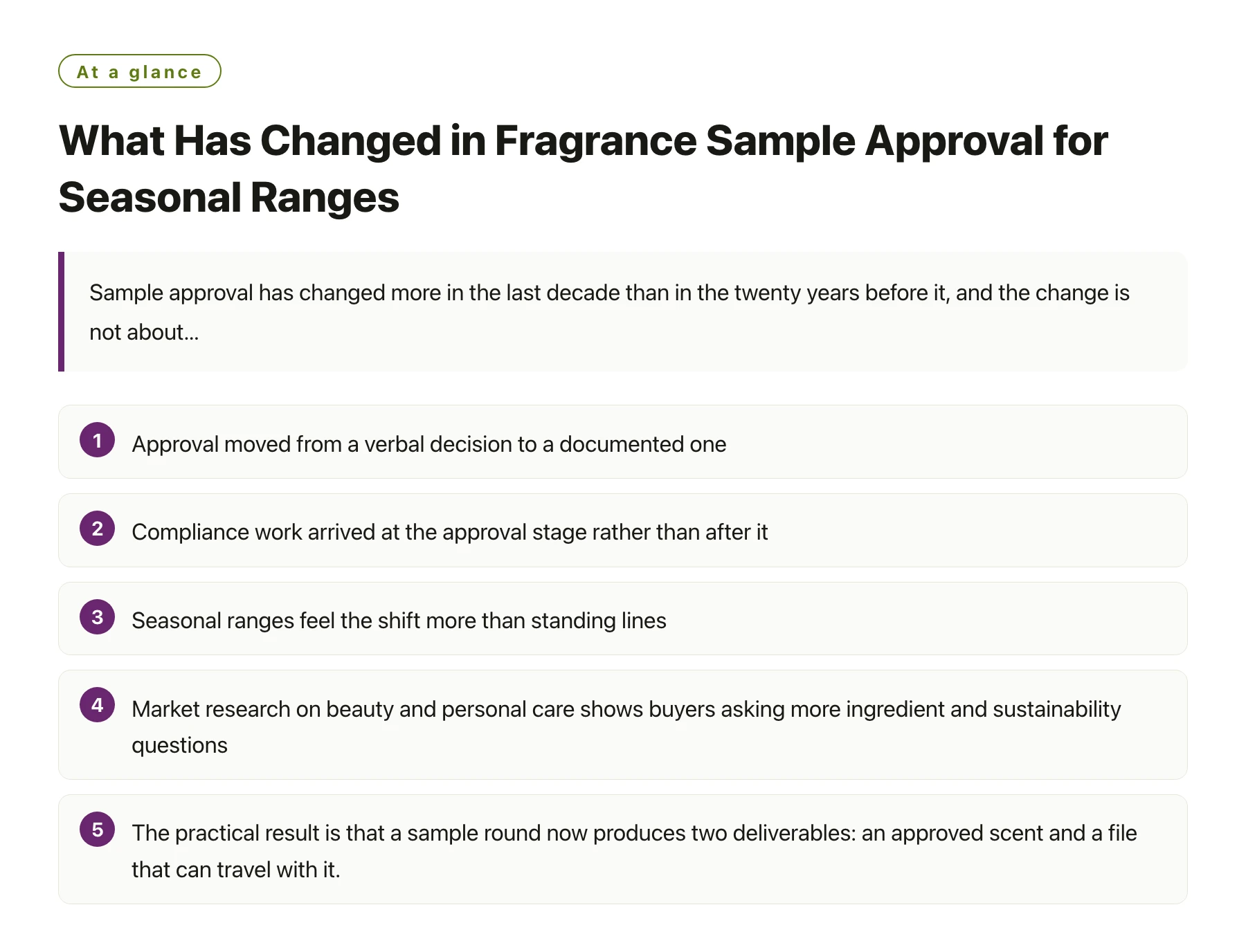
- Approval moved from a verbal decision to a documented one, with the reference sample and its specification retained together.
- Compliance work arrived at the approval stage rather than after it, because restricted materials and allergens now change the label.
- Seasonal ranges feel the shift more than standing lines, since a fixed window leaves no room to repair documentation later.
- Market research on beauty and personal care shows buyers asking more ingredient and sustainability questions, which pushed transparency upstream into development [1].
- The practical result is that a sample round now produces two deliverables: an approved scent and a file that can travel with it.
Ask anyone who has run fragrance development for a long time what changed, and they rarely mention the materials first. They mention the paperwork, the number of questions, and the fact that a formula can no longer be adjusted quietly after a range has been signed off.
That shift arrived gradually. Ingredient inventories became public, labelling requirements tightened in the major markets, and retail buyers started asking suppliers for evidence rather than assurances. The industry press has tracked those pressures as they moved from the compliance department into the commercial conversation [2].
For a seasonal range, the effect is concentrated. There is no second window in which to fix a missing declaration, so anything that used to be repaired after launch now has to be right at approval.
Four shifts, in the order they changed the work
The changes did not arrive as one reform. Each of them added something to the approval meeting, and together they explain why the round feels heavier than it used to. The practical consequence is that an approval meeting now needs scope as well as scent. See more on what a manufacturer's published scope typically covers, and use it to decide which documents you expect during the round rather than at the end of it.
The first was the move to written approval. The second was bringing compliance forward. The third was retaining the reference as a controlled item rather than a keepsake. The fourth was the expectation that a supplier can explain its reasoning, not only deliver a sample.
From a decision to a record
Older practice often ended with an email saying the direction was approved, and sometimes not even that. Today the useful record is a dated specification plus the vial it describes. This is not bureaucracy for its own sake: when a bulk batch is compared against the reference, the comparison needs to know exactly what the reference was.
Compliance moved upstream
Restricted-material limits and allergen declarations used to be handled after the scent was chosen. Now they constrain the choice itself, which is why the approval meeting includes a declaration list. Fragrance houses publish material on safe use and material transparency precisely because those questions now arrive during development rather than after it [3].
Seasonality raised the stakes
A standing line can absorb a documentation delay by shifting a production slot. A seasonal drop cannot, because the retail window is fixed. The same change therefore costs more on a seasonal range, and the mitigation is to complete the file before the formula is frozen rather than alongside the first order.
Then and now in sample approval
| Aspect | A generation ago | A seasonal range today |
|---|---|---|
| What counts as approval | A verbal or emailed yes to a direction | A dated specification plus the sealed reference sample |
| When compliance is handled | After the scent is chosen, often before shipping | During the round, before the formula is frozen |
| What the supplier provides | A sample and a price | A sample, a cost picture at volume and the documentation that travels with it |
| How the reference is treated | Kept informally, sometimes not at all | Stored sealed and labelled as the standard for bulk comparison |
| What the buyer asks for | Reassurance that the scent matches the brief | Evidence: test records, declaration lists and a traceable specification |
| Where the round fails | The wrong direction was chosen | A decision or a document was never produced in time |
Two rows in that table are worth framing on the wall. The shift in what counts as approval is what protects the brand later, and the shift in when compliance is handled is what makes the seasonal calendar feasible. Everything else follows from those two.
What this means for a seasonal calendar
The calendar consequence is straightforward: the sample round is now longer in working time and shorter in waiting time. There is more to prepare before the brief goes out, because the declaration requirements of the target markets should shape the brief rather than surprise it.
There is also a new dependency on the partner's depth. A supplier that maintains its own reference library and documentation practice can answer questions during development without stopping the project. Longevity in this industry tends to show up exactly there, in the routine parts of the process rather than in the marketing pages, which is why a partner's history is worth reading as a process signal — the sort of background described in a page about Xuelei's 31 years in fragrance is less interesting as a number than as an indication that the routines have been run many times.
For brands using a partner that takes more of the development work on itself, such as a full ODM fragrance service, the practical change is who produces the evidence. The brand still has to hold the file, but it does not have to build it from scratch. What it must not do is assume the file exists because the sample was good.
Add a documentation buffer to the schedule
Seasonal plans usually build in time for production and freight. Add time for the file: the declaration list, the label wording and the comparison record. None of it takes long individually, and all of it takes longer when it is the last thing before a shipment date.
Ask for the evidence format early
Ask what the documents will look like and in what format they arrive, then test that answer with one real request during the round. A supplier that cannot produce a sample document during development is unlikely to produce a complete set at the end of it.
The change that catches brands out is not the extra paperwork; it is the assumption that the paperwork is administrative. In practice the documents are the product of decisions taken during development: which materials are in the formula, at what dosage, in which markets, under which label. Treat them as outputs of the sample round and they arrive on time. Treat them as a task for the last week, and they become the reason a seasonal launch slips past a window it cannot recover.
What has not changed
The scent still has to be right, and that judgement is still made by smelling. The brief still decides more than any other document, and a team that writes a precise one still needs fewer rounds than a team that does not. A personal relationship with a supplier is still worth more than a directory listing.
What changed is the amount of evidence that surrounds those constants. Approval now carries a file, compliance shapes the brief, and the reference sample is a controlled object rather than a memory aid. A seasonal range that plans for that reality is not doing more work than the ranges of the past; it is doing the same work in a different order, so that nothing is left to the final week.
Sources
- Mintel Press Centre —— Mintel's press releases on consumer and beauty market research, including fragrance and personal care trend reporting.
- Cosmetics Business —— A trade publication covering the beauty and cosmetics industry, including fragrance launches and regulatory developments.
- dsm-firmenich —— A global fragrance, flavour and nutrition company; public information on perfumery, ingredients and sustainability programmes.
Frequently asked questions
Has sample approval really become more complicated?
It has become more documented rather than more complicated. The judgement is still sensory, but approval now also produces a specification, a declaration list and a retained reference. Those items did not exist in older informal practice, and they are what markets and retailers now expect to see.
Why does compliance now happen during development?
Because restricted materials and allergens affect what can be in the formula and what must appear on the label. Handling them after the scent is chosen means the choice may have to be remade, and on a seasonal calendar there is usually no time for that.
Does a seasonal range need more documentation than a standing line?
The same documentation, but less tolerance for delay. A standing line can often absorb a later production slot; a seasonal drop is tied to a window that will not move, so the file has to be complete before the formula is frozen.
What should be retained after a sample is approved?
The sealed reference sample, labelled with the approval date, plus the specification it was made to and the declaration list for the target markets. Those three items are what allow a bulk batch to be compared against something objective.
How can a brand tell whether a supplier can keep up with the documentation?
Ask for one real document during the round rather than a description of the process. A supplier that produces a declaration list or a comparison record during development is demonstrating the same capability that will be needed at the end of the order.
Strategy is what happens between the returns — that's where the savings live.